Chapter 9
I guess Simon switches between events in the book because he is following the time span in which these events happened.
I understand that, but I think to an extent I'd like it if there wasn't such a long span between related events.
At the end of chapter seven, Simon says Nolan's squad is breaking apart. That still hasn't been addressed, and in this chapter, clearance rate is good and everything seems dandy.
At the beginning of chapter nine, another young girl's body is found. Simon follows Edgerton along on the investigation for a while, then it switches to information about the court system.
Then Frazier's trial, the man who killed Lena Lucas and Purnell Booker in chapter four.
I find the switching around (even though the time frame makes it logical, and more like a year in the life) takes away from the impact. Those deaths occurred 3 chapters (so three weeks for me) ago, and many people have died between then and now.
I found myself waiting to slog through the rest of this chapter so I can find out more about Andrea Perry.
BUT I might just be impatient.
Once bitten, twice shy
"Success is its own catalyst; failure too," page 460.
Even though in this case it seems better that there is only one detective working, I find it sad, and I guess disheartening that because the Latonya Wallace case didn't get solved the detectives don't want to try.
Isn't that their job?
They've given up hope, and it's interesting how it wasn't that hard. Maybe this is the work of a serial killer, or at least be the start of some justice.
(Though again, it seems better that they don't help.)
Expectations vs. Reality
"9A. To a jury, any doubt is reasonable.
9B. The better the case, the worse the jury.
And, in addition to rules 9A and 9B:
9C. A good man is hard to find, but twelve of them, gathered together in one place, is a miracle," page 469.
Simon gives statistics as to how effective* the prison system is. His wording, "And if you factor in those unsolved homicides in which there are no arrests, the chance of being caught and convicted for taking a life in Baltimore is just over 40 percent. All of which is not to say that the unlucky minority then suffers punishment commensurate with their crime," page 472.
Based on this wording it seems that Simon (or the detectives) think that the system is largely ineffective. When you consider that 40 per cent of people who go through the courts system are charged it does seem that way.
But the reasons are things like:
- Death
- Self-defense
- Mental illness (not criminally responsible)
- Lack of evidence
Isn't it good that people aren't being thrown into prison because of these things (minus death.) The prison system shouldn't be something that is used to create money (cough cough), or as a warning to others. It should only be for people who have committed a crime, and if it can't be proven, it sucks but they shouldn't go to jail.
*criminals who are put into prison
Television is misleading part: 9534798347698326
As I've mentioned before, television has impacted my perception of police officers, medical examiners, and detectives. (What? They're not all like Sherlock?)
But it's interesting that the perceptions people form from television can make them bad jurors.They think that decisions should be black and white, evidence is easy to come by.
I wonder what, if anything has been done to combat juror apathy in modern courts. Is there training? Or perhaps the climate is so different (at least in Mantioba) than the climate was in Baltimore in the 70s that it isn't really a problem any more. I'm looking forward to learning more about trials next semester.
Sunday, 23 November 2014

Sunday, 16 November 2014
Homicide: A Year on the Killing Streets 8
Before starting this chapter I heated up some leftover chick pea curry, sat down with the bowl, and started reading.
"Pulling from behind the ears, the skin of the victim's scalp is then folded forward across the face so that any head wound can be tracked and the brain itself can be removed, weighed and examined for disease," page 410.
Oh. Never mind. Not hungry.
Workplace fun: not always acceptable
"Before Smialek's arrival, the autopsy room was indeed a less formal place. Coffee and cigarettes were bartered and shared in the cutting room with a six-pack or two, treating the cutters to some early relief from the weekend rush that always began with Friday night's violence," page 404.
For some strange reason, this behavior doesn't seem at all appropriate for a medical examiner's office. I guess it would be less offensive if it didn't impact their jobs, but sometimes it impacted the integrity of evidence.
Smialek was able to get the examining room in check, even if he is on a power trip.
According to Worden, this resulted in more respect for the dead. This might not be the ultimate goal, or even important for an autopsy room, but it is a plus.
I think that the dead deserve respect. I don't expect examiners and detectives to cry over bodies, or care really, but laughing at people's genitals, at least in my head crosses a line.
Simon explains it's what keeps a homicide detective sane, and I understand that. I also think there's a line. Just because someone is dead doesn't mean they were not at some point human.
Not quite like CSI
I can't look at blood. I don't even like to think about blood.
SO this chapter was pretty intense, and for some reason it was way more gruesome than I had anticipated.

Simon (so probably the detectives) refer to the examiners as cutters. Gross. Sometimes there's bodies lined up in the halls. Gross.
But one thing that is distinctly unlike television, is the amount of time it takes for things to get done. Since the detectives need to start investigating immediately, toxicology tests and the like will not be finished. If this was CSI they'd pull one hair off the body, and run it through some high-tech system then a picture and address of the perp would come up.
Of course that's not what my perception of autopsy was (well maybe to an extent) but this chapter made me realize that I had no idea what their jobs were like. I am thankful that I have not had to witness an autopsy, and (fingers crossed) I hope I never do.
Business as usual
The second part of this chapter follows the Homicide detectives on cases, which is super interesting, but at times repetitive. I think that's what makes this book so honest. Not each death is treated like a special snowflake, because it isn't.
Language
"It's a two story dump on North Bond Street and, of course, there are no witnesses- just a bunch of burned furniture and one crispy critter in the middle room. Some smokehound, an old guy, maybe sixty. The poor bastard is lying there like a piece of chicken that someone forgot to turn over..." page 441.
Well, this man has been stripped of all dignity. He's been reduced to a burnt body, and Simon compares him to an animal, twice.
Maybe this man wasn't the best person, I don't know, but does Simon? This guy probably died in excruciating pain. Maybe describing him as a burnt piece of chicken is fair, if that's what he looked like, but "crispy critter" is a bit much.
"Lenore, the mystery whore," page 449.
Come on. Sure she's a prostitute, and that the rhyming is clever and what not, but as a journalist, unless she called her self a whore, or if one of the detectives did (maybe they did) I don't think it's Simon's place to go around throwing words like whore and smokehound.
If the someone else use's them that's fair game, but he should make that clear instead of presenting it as fact.
"Pulling from behind the ears, the skin of the victim's scalp is then folded forward across the face so that any head wound can be tracked and the brain itself can be removed, weighed and examined for disease," page 410.
Oh. Never mind. Not hungry.
Workplace fun: not always acceptable
"Before Smialek's arrival, the autopsy room was indeed a less formal place. Coffee and cigarettes were bartered and shared in the cutting room with a six-pack or two, treating the cutters to some early relief from the weekend rush that always began with Friday night's violence," page 404.
For some strange reason, this behavior doesn't seem at all appropriate for a medical examiner's office. I guess it would be less offensive if it didn't impact their jobs, but sometimes it impacted the integrity of evidence.
Smialek was able to get the examining room in check, even if he is on a power trip.
According to Worden, this resulted in more respect for the dead. This might not be the ultimate goal, or even important for an autopsy room, but it is a plus.
I think that the dead deserve respect. I don't expect examiners and detectives to cry over bodies, or care really, but laughing at people's genitals, at least in my head crosses a line.
Simon explains it's what keeps a homicide detective sane, and I understand that. I also think there's a line. Just because someone is dead doesn't mean they were not at some point human.
Not quite like CSI
I can't look at blood. I don't even like to think about blood.
SO this chapter was pretty intense, and for some reason it was way more gruesome than I had anticipated.
Simon (so probably the detectives) refer to the examiners as cutters. Gross. Sometimes there's bodies lined up in the halls. Gross.
But one thing that is distinctly unlike television, is the amount of time it takes for things to get done. Since the detectives need to start investigating immediately, toxicology tests and the like will not be finished. If this was CSI they'd pull one hair off the body, and run it through some high-tech system then a picture and address of the perp would come up.
Of course that's not what my perception of autopsy was (well maybe to an extent) but this chapter made me realize that I had no idea what their jobs were like. I am thankful that I have not had to witness an autopsy, and (fingers crossed) I hope I never do.
Business as usual
The second part of this chapter follows the Homicide detectives on cases, which is super interesting, but at times repetitive. I think that's what makes this book so honest. Not each death is treated like a special snowflake, because it isn't.
Language
"It's a two story dump on North Bond Street and, of course, there are no witnesses- just a bunch of burned furniture and one crispy critter in the middle room. Some smokehound, an old guy, maybe sixty. The poor bastard is lying there like a piece of chicken that someone forgot to turn over..." page 441.
Well, this man has been stripped of all dignity. He's been reduced to a burnt body, and Simon compares him to an animal, twice.
Maybe this man wasn't the best person, I don't know, but does Simon? This guy probably died in excruciating pain. Maybe describing him as a burnt piece of chicken is fair, if that's what he looked like, but "crispy critter" is a bit much.
"Lenore, the mystery whore," page 449.
Come on. Sure she's a prostitute, and that the rhyming is clever and what not, but as a journalist, unless she called her self a whore, or if one of the detectives did (maybe they did) I don't think it's Simon's place to go around throwing words like whore and smokehound.
If the someone else use's them that's fair game, but he should make that clear instead of presenting it as fact.
Homicide: A Year on the Killing Streets 7
Chapter 7
"Summer is the season of motiveless murder, of broken-blade steak knives and bent tire irons; it's the time for truly dangerous living, the season of massive and immediate retaliation, the 96-degree natural habitat of the Argument That Will Be Won."
Why do homicide detectives like their jobs again?
How does Simon know?
"She was the tiniest thing, barely eighteen and a hundred pounds dripping wet, and her bastard of a step father waiting only long enough for his wife to go out of town for a week. he brought three friends for Saturday night and after a six-pack, the four of them took turns on her, then strangled her by wrapping a towel around her neck and pulling it in different directions. "Why are you doing this?" she asked, pleading. "Sorry," her stepfather told her. "We got to."
These details are part of what makes this book so good, but I can't help but wonder exactly how Simon knows what happened. Likely he was able to gather that information from a police interview, or maybe he interviewed the man himself. It strikes me as odd that this man would offer details about what this girl said, considering it could be used against him. I don't doubt that it's all true though.
"Kill it, says the voice in Edgerton's head. Kill it now," page 365.
I can't help but think "he can't be in Edgerton's head... this is false."
But he must have told Simon what he was thinking. In a shorter story (though of course there are no rules, this is just what I've observed through reading) the quote would go something along the lines of "I was thinking "kill it!" said Edgerton. Or even, Edgerton thought about killing it. This is far more creative.
I'm not as used to long form journalism. I'd be hesitant to write something along those lines in one of my stories for school because of the "sez who?"
Which does make sense, because now I'm sitting here thinking "sez who."
Almost
In short, Simon's word choice bothered me and I spent way too long thinking about it.
"Fair enough," says Edgerton, almost amused," page 359.
"Considering it's Edgerton, the banter is easy and almost affectionate," page 360.
"No, says Nolan, almost amused," page 390. (To Edgerton in a phone call.)
Considering Edgerton is the common factor, it made me think Simon is trying to tell us something (since almost -blank- isn't the best word choice, especially from a writer who is so good at describing.)
Is he trying to say Edgerton is almost there as a detective? He's almost there in terms of camaraderie with his coworkers? Maybe he's saying they're just shy of being affectionate toward him, but they could get there.
OR
It could mean that he isn't there yet, and will never be. The end of this chapter does have a cliff hanger ending worthy of an episode in a dramatic television series. (The kind where you really have stuff to do, but oh man you totally didn't see that coming-would one more episode hurt?)
OR
Maybe it means nothing at all and Simon was tired this chapter. I did notice a fair few passive sentences. It could be lazy writing, but that doesn't seem likely. I'll stick with my other theories for now.
Stranger than fictionDollie Brown was shot in the head. Then she had her throat slit, then she was shot in the head several more times. She survived.
What.
Brown's aunt Geraldine Parrish tried to have her assassinated several times because she would receive insurance money. Brown is not the only person who Parrish took out insurance for. (She is an awful woman.)
"They [her family] feared her because they believed that she has a special power, that she knew voodoo and hexes and all kinda of Carolina backwoods garbage," page 375.
What.
"The two men [two out of five of Parrish's husbands] sit together like bookends on the fishbowl sofa, each believing the other to be nothing more than a tenant at the East Baltimore home," page 376.
What.
I doubt Simon will write more about Parrish's escapades in the next chapter, but I would really like him to. She is so easy to hate and so fascinating.
"Summer is the season of motiveless murder, of broken-blade steak knives and bent tire irons; it's the time for truly dangerous living, the season of massive and immediate retaliation, the 96-degree natural habitat of the Argument That Will Be Won."
Why do homicide detectives like their jobs again?
How does Simon know?
"She was the tiniest thing, barely eighteen and a hundred pounds dripping wet, and her bastard of a step father waiting only long enough for his wife to go out of town for a week. he brought three friends for Saturday night and after a six-pack, the four of them took turns on her, then strangled her by wrapping a towel around her neck and pulling it in different directions. "Why are you doing this?" she asked, pleading. "Sorry," her stepfather told her. "We got to."
These details are part of what makes this book so good, but I can't help but wonder exactly how Simon knows what happened. Likely he was able to gather that information from a police interview, or maybe he interviewed the man himself. It strikes me as odd that this man would offer details about what this girl said, considering it could be used against him. I don't doubt that it's all true though.
"Kill it, says the voice in Edgerton's head. Kill it now," page 365.
I can't help but think "he can't be in Edgerton's head... this is false."
But he must have told Simon what he was thinking. In a shorter story (though of course there are no rules, this is just what I've observed through reading) the quote would go something along the lines of "I was thinking "kill it!" said Edgerton. Or even, Edgerton thought about killing it. This is far more creative.
I'm not as used to long form journalism. I'd be hesitant to write something along those lines in one of my stories for school because of the "sez who?"
Which does make sense, because now I'm sitting here thinking "sez who."
Almost
In short, Simon's word choice bothered me and I spent way too long thinking about it.
"Fair enough," says Edgerton, almost amused," page 359.
"Considering it's Edgerton, the banter is easy and almost affectionate," page 360.
"No, says Nolan, almost amused," page 390. (To Edgerton in a phone call.)
Considering Edgerton is the common factor, it made me think Simon is trying to tell us something (since almost -blank- isn't the best word choice, especially from a writer who is so good at describing.)
Is he trying to say Edgerton is almost there as a detective? He's almost there in terms of camaraderie with his coworkers? Maybe he's saying they're just shy of being affectionate toward him, but they could get there.
OR
It could mean that he isn't there yet, and will never be. The end of this chapter does have a cliff hanger ending worthy of an episode in a dramatic television series. (The kind where you really have stuff to do, but oh man you totally didn't see that coming-would one more episode hurt?)
OR
Maybe it means nothing at all and Simon was tired this chapter. I did notice a fair few passive sentences. It could be lazy writing, but that doesn't seem likely. I'll stick with my other theories for now.
Stranger than fictionDollie Brown was shot in the head. Then she had her throat slit, then she was shot in the head several more times. She survived.
What.
Brown's aunt Geraldine Parrish tried to have her assassinated several times because she would receive insurance money. Brown is not the only person who Parrish took out insurance for. (She is an awful woman.)
"They [her family] feared her because they believed that she has a special power, that she knew voodoo and hexes and all kinda of Carolina backwoods garbage," page 375.
What.
"The two men [two out of five of Parrish's husbands] sit together like bookends on the fishbowl sofa, each believing the other to be nothing more than a tenant at the East Baltimore home," page 376.
What.
I doubt Simon will write more about Parrish's escapades in the next chapter, but I would really like him to. She is so easy to hate and so fascinating.
Saturday, 15 November 2014
Homicide: A Year on the Killing Streets 6
Chapter six
The biggest part of this chapter is the trial of Butchie Frazier, a man who shot and blinded police officer Gene Cassidy.
(And McLarney going off the rails after.)
Suited for the job
"It was a grim, pathetic parade, a chain of human misery for which Bothe was psychologically as well as temperamentally suited," page 294.
(Note: Finally a powerful, intelligent woman!)
Bothe is a judge, which means she makes decisions about life and death. She sits and listens to people talk about brutal crimes. I don't think this is a job most people would be able to do.
Something I've gathered from this book is that some people are better suited for certain jobs than others. It makes me wonder if this is a disposition based on their inherent nature or values.
In chapter five, Simon says homicide detectives must be clinical about the way they handle their cases.
But it isn't just homicide detectives or judges.
"'A-D-A-S-T-W,' she says with a certain pride. 'Arrived dead and stayed that way.' Beautiful. Is it any wonder that the easiest extramarital affair for a cop is with an emergency room nurse? What other relationship could be so psychologically symbiotic, so happily diseased in perspective?" Page 283 (chapter five.)
Do they learn to emotionally distance themselves? Or are they people who are already able to have that disconnect, which isn't to say that they don't care. Instead of crying or becoming irrational, they figure the case out.
"Normal people. Citizens. Human beings. Even among the believers, there is a certain pathology to being a cop," page 311.
Does being emotionally suited to a job play a certain role?
I have friends who are nurses, and for the most part they are nurturing people. Do they become that way because they are nurses, or do they become nurses because they are that way.
I wonder about what sort of emotional state it takes to be a journalist.
Tricks of the trade
A good defense attorney sits close to his client, touches him on the shoulder to get his attention, puts an arm around him to show the jurors that he likes this man, that he believes in him. Some lawyers go so far as to give defendants mints or hard candies, telling clients to pull them out at a quiet moment and offer one to the lawyer, perhaps even to the prosecutor, seated a few seats away. See, ladies and gentlemen, he's human."
Like the example of the fax-machine-lie-detector, within the justice system, there are ways of knowing how to persuade people. It doesn't seem all that bad when it results in someone confessing to murder (if they have actually committed that murder,) but when it means a criminal doesn't serve time it's a lot more greasy.
The biggest part of this chapter is the trial of Butchie Frazier, a man who shot and blinded police officer Gene Cassidy.
(And McLarney going off the rails after.)
Suited for the job
"It was a grim, pathetic parade, a chain of human misery for which Bothe was psychologically as well as temperamentally suited," page 294.
(Note: Finally a powerful, intelligent woman!)
Bothe is a judge, which means she makes decisions about life and death. She sits and listens to people talk about brutal crimes. I don't think this is a job most people would be able to do.
Something I've gathered from this book is that some people are better suited for certain jobs than others. It makes me wonder if this is a disposition based on their inherent nature or values.
In chapter five, Simon says homicide detectives must be clinical about the way they handle their cases.
But it isn't just homicide detectives or judges.
"'A-D-A-S-T-W,' she says with a certain pride. 'Arrived dead and stayed that way.' Beautiful. Is it any wonder that the easiest extramarital affair for a cop is with an emergency room nurse? What other relationship could be so psychologically symbiotic, so happily diseased in perspective?" Page 283 (chapter five.)
Do they learn to emotionally distance themselves? Or are they people who are already able to have that disconnect, which isn't to say that they don't care. Instead of crying or becoming irrational, they figure the case out.
"Normal people. Citizens. Human beings. Even among the believers, there is a certain pathology to being a cop," page 311.
Does being emotionally suited to a job play a certain role?
I have friends who are nurses, and for the most part they are nurturing people. Do they become that way because they are nurses, or do they become nurses because they are that way.
I wonder about what sort of emotional state it takes to be a journalist.
Tricks of the trade
A good defense attorney sits close to his client, touches him on the shoulder to get his attention, puts an arm around him to show the jurors that he likes this man, that he believes in him. Some lawyers go so far as to give defendants mints or hard candies, telling clients to pull them out at a quiet moment and offer one to the lawyer, perhaps even to the prosecutor, seated a few seats away. See, ladies and gentlemen, he's human."
Like the example of the fax-machine-lie-detector, within the justice system, there are ways of knowing how to persuade people. It doesn't seem all that bad when it results in someone confessing to murder (if they have actually committed that murder,) but when it means a criminal doesn't serve time it's a lot more greasy.
Tuesday, 11 November 2014
Remembrance Day photo essay
I attended the service at Vimy Ridge Memorial Park for Remembrance day.

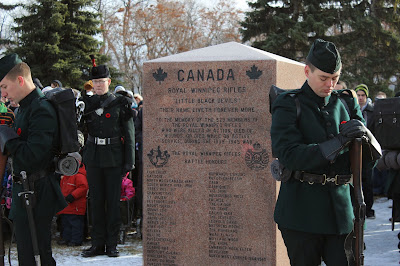


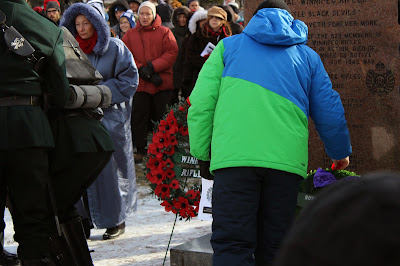
Men stand by the wreaths before the service starts.
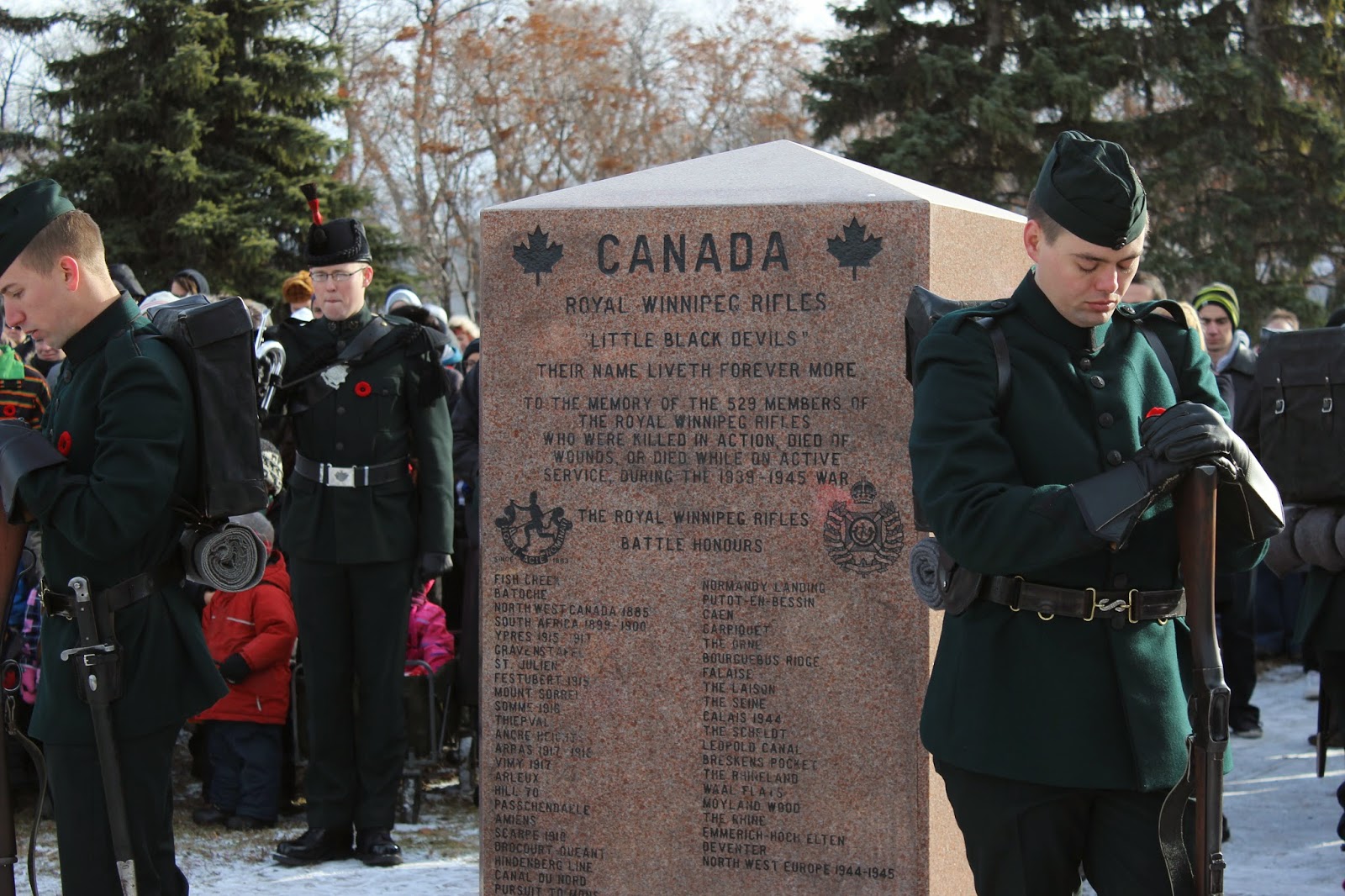
Men from the Royal Winnipeg Rifles guard a monument with the names of those who died in active service.

Two veterans salute the wreaths they placed by the monument.

A couple watches the service.

A young boy is the first to pin his poppy on the wreath.
Sunday, 26 October 2014
Homicide: A Year on the Killing Streets 5
Chapter 5
When does a person stop being a person?
"For Tom Pellegrini, the 3-by-5 color shots no longer produce anything that remotely resembles an emotion. In fact, he concedes to himself, they never really did. In some strange way that only a homicide detective can understand, Pellegrini psychologically stepped away from his victim at the very outset."
As the Latonya Wallace case sinks further into the past, it seems like she becomes less of a person, she's just an unsolved case. In chapter two, when her body is found, Simon says that even homicide detectives want to bring her in from the rain, but on page 243 Pellegrini refers to her as a "broad."
He doesn't care about her, and it's attributed to a few reasons, the colour of her skin, where they live, him being a desensitized homicide detective.
It makes sense that detectives should harden themselves against the realities of their job, but I find the way he thinks about Wallace sad, like she's not real, and never was.
It would be different if there was more of a perspective from the family, but I suppose the book isn't about them-it's about the unit.
It just goes to show how a perspective from a person can change a story.
There can be a cost for detectives to get emotionally involved in a case. There's a choice for them- they either become impartial, even joke about it, or let it get to them.
"More than most homicides, the Kirk Avenue arson had an emotional cost; Steinhice, a detective with perhaps a thousand crimes behind him, suffered nightmares about a murder for the first time-graphic images of helplessness in which dead children were at the top of a rowhouse stairway crying, terrified," page 264.
When does a person stop being a person?
"For Tom Pellegrini, the 3-by-5 color shots no longer produce anything that remotely resembles an emotion. In fact, he concedes to himself, they never really did. In some strange way that only a homicide detective can understand, Pellegrini psychologically stepped away from his victim at the very outset."
As the Latonya Wallace case sinks further into the past, it seems like she becomes less of a person, she's just an unsolved case. In chapter two, when her body is found, Simon says that even homicide detectives want to bring her in from the rain, but on page 243 Pellegrini refers to her as a "broad."
He doesn't care about her, and it's attributed to a few reasons, the colour of her skin, where they live, him being a desensitized homicide detective.
It makes sense that detectives should harden themselves against the realities of their job, but I find the way he thinks about Wallace sad, like she's not real, and never was.
It would be different if there was more of a perspective from the family, but I suppose the book isn't about them-it's about the unit.
It just goes to show how a perspective from a person can change a story.
There can be a cost for detectives to get emotionally involved in a case. There's a choice for them- they either become impartial, even joke about it, or let it get to them.
"More than most homicides, the Kirk Avenue arson had an emotional cost; Steinhice, a detective with perhaps a thousand crimes behind him, suffered nightmares about a murder for the first time-graphic images of helplessness in which dead children were at the top of a rowhouse stairway crying, terrified," page 264.
Sunday, 19 October 2014
Homicide: A Year on the Killing Streets 4
This chapter follows Richard Garvey while he investigates the murder of Lena Lucas and Purnell Booker. Simon also includes a lengthy description of the interrogation process, which is far more deceitful, though understandably, than I had thought. I wonder if interrogation is still like that in modern police work.
The Baltimore homicide unit gets back up staff because their clearance rate (crimes closed by arrest) is too low. Essentially they've hit "rock bottom."
Slanted statistics
The colonel decides to intervene in the homicide unit because their clearance rate is at 36 per cent. That's pretty bad, but there are factors that weren't taken into account.
"There is no point in explaining that three fifths of D'Addario's homicides happen to be drug-related, just as seven of those solved by Stanton's shift are domestics or other arguments," page 194.
Drug related murders are harder to solve, domestics have a clear suspect.
This isn't reflected in that 36 per cent.
"The homicide clearance rate is equally vulnerable to subtle forms of manipulation-all of which are permitted under the FBI's guidelines for uniform crime reporting," page 195.
This manipulation means any time a suspect spends behind bars-whether it goes to a grand jury or not, counts as a solved case. A solved crime from the previous year can be carried over to the next, or vice versa.
In journalism, research gives our work authority and credibility. Online, there is a ton of pie charts, percentages, and numbers laid out for easy consumption.
BUT
As shown, there's many factors that can come into play when a statistic is used to represent something, there can be a lot of variables.
I think statistics are a good way to show a representation of what is happening, and no matter how many tactics the homicide unit uses, it's still clear they're in trouble. Hypothetically, I would use this statistic in one of my stories, but a number doesn't show everything.
Statistics should be used, but responsibly. Journalists should do research and be cautious about biased numbers or research. Numbers can provide a strong base to any story, it just should be a fair representation.
Body language, or lack thereof
"As he begins asking questions, Garvey touches the young woman's elbow lightly, as if to emphasize that only the truth should pass between them," page 180.
Body language is so important, it conveys emotion, as shown above. In my journalism schooling, I've heard two perspectives from two different instructors on how reporters should act during interviews. They're both right, they're obviously both experienced so I think it's just a matter of choosing what's more comfortable.
The first is visual engagement. Nodding, encouraging statements like "oh yeah," or mouthing the words because the camera and mic are on. This is the method tend to use without realizing it. When I'm interviewing someone I'm actively listening because I find their story interesting, and so I can think of follow up questions.
Embarrassing story: I'm a video beat reporter, and I was interviewing someone on campus, and someone I know was watching. They took a video of me while I was interviewing. I was nodding like a bobble head for thirty seconds. I was humiliated when I saw the video because I didn't even realize I did that.
While I look dumb, people tend to keep talking when I do that. I do think that this method depends on what the story is.
Another instructor said that a woman was the best reporter there is because she asks questions and then dead pans until she gets an answer. I see the merit to this, and since I only heard it a few days ago, I have yet to try it.
The Baltimore homicide unit gets back up staff because their clearance rate (crimes closed by arrest) is too low. Essentially they've hit "rock bottom."
Slanted statistics
The colonel decides to intervene in the homicide unit because their clearance rate is at 36 per cent. That's pretty bad, but there are factors that weren't taken into account.
"There is no point in explaining that three fifths of D'Addario's homicides happen to be drug-related, just as seven of those solved by Stanton's shift are domestics or other arguments," page 194.
Drug related murders are harder to solve, domestics have a clear suspect.
This isn't reflected in that 36 per cent.
"The homicide clearance rate is equally vulnerable to subtle forms of manipulation-all of which are permitted under the FBI's guidelines for uniform crime reporting," page 195.
This manipulation means any time a suspect spends behind bars-whether it goes to a grand jury or not, counts as a solved case. A solved crime from the previous year can be carried over to the next, or vice versa.
In journalism, research gives our work authority and credibility. Online, there is a ton of pie charts, percentages, and numbers laid out for easy consumption.
BUT
As shown, there's many factors that can come into play when a statistic is used to represent something, there can be a lot of variables.
I think statistics are a good way to show a representation of what is happening, and no matter how many tactics the homicide unit uses, it's still clear they're in trouble. Hypothetically, I would use this statistic in one of my stories, but a number doesn't show everything.
Statistics should be used, but responsibly. Journalists should do research and be cautious about biased numbers or research. Numbers can provide a strong base to any story, it just should be a fair representation.
Body language, or lack thereof
"As he begins asking questions, Garvey touches the young woman's elbow lightly, as if to emphasize that only the truth should pass between them," page 180.
Body language is so important, it conveys emotion, as shown above. In my journalism schooling, I've heard two perspectives from two different instructors on how reporters should act during interviews. They're both right, they're obviously both experienced so I think it's just a matter of choosing what's more comfortable.
The first is visual engagement. Nodding, encouraging statements like "oh yeah," or mouthing the words because the camera and mic are on. This is the method tend to use without realizing it. When I'm interviewing someone I'm actively listening because I find their story interesting, and so I can think of follow up questions.
Embarrassing story: I'm a video beat reporter, and I was interviewing someone on campus, and someone I know was watching. They took a video of me while I was interviewing. I was nodding like a bobble head for thirty seconds. I was humiliated when I saw the video because I didn't even realize I did that.
While I look dumb, people tend to keep talking when I do that. I do think that this method depends on what the story is.
Another instructor said that a woman was the best reporter there is because she asks questions and then dead pans until she gets an answer. I see the merit to this, and since I only heard it a few days ago, I have yet to try it.
Sunday, 12 October 2014
Homicide: A Year on the Killing Streets 3

The first half of chapter three follows Terrence McLarney as he investigates the shooting of Gene Cassidy.
The second half describes the ongoing investigation of the murder of Latonya Wallace, which is still disappointingly unsuccessful.
Before I get into what bothered me about this chapter, and the book thus far, I'd again like to point out how good Simon is at writing.
He is able to express so much about Mclarney's personality, without saying 'he's a pretty good guy.' He does say "Yet McLarney was also one of the most intelligent, self-aware men in homicide," page 144. But I think that he could have been left that out, and continued with the descriptive details that he already had written.
"McLarney, who as a sergeant spent a single day sharing an office with Landsman before deadpanning a confidential memo to D'Addario: 'Sgt. Landsman stares at me strangely. I am concerned he views me as a sex object.' McLarney, who after four beers spoke in football metaphors and would always offer his officers the same shred of advice: 'My men should go into the game with a plan. I don't want to know what it is, but they should have one.' Mclarney, who once drove home on a busy shift to rescue his wife and son by using his .38 to shoot a rampaging mouse in the bedroom closet," page 144.
The last part of this quote brings me into something that bothers me about this book, not that it's in any way Simon's fault-it's just indicative of the times.
For the most part, women in this book are wives, girlfriends, 'whores', or victims. They're crying, scared, or stabbed.
This book is non-fiction, so Simon can't change what happened to make it more fair. But I'd really like to see a bad-ass female detective busting perps.
Even when women are suspects, or committing a crime, it's still not a display of power in the same way as when men commit crimes.
"And the is-this-a-great-city-or-what homicide that Fred Ceruti handles in a Cathedral Street apartment, where one prostitute plunges a knife into the chest of another for a $10 cap of heroin, then fires the drugs before the police arrive," page 171.
This isn't a hard and fast rule, but it seems to me in this book, men are protectors, and women are in need of protection.
"In McLarney's squad, detectives who caught a case with a female victim were routinely prodded and henpecked by their sergeant, a cop governed by the traditional, sentimental judgement that while men might violate the law by killing each other, the murder of a woman constituted real tragedy," page 145.
Wait, what? Killing a woman is worse than killing a man?
This seems based off of the assumption that women are not able to fend for themselves.
Though police work is still very much a male dominated profession, I had the opportunity to go to an IAWP (International Association of Women Police) conference a couple weeks ago.
I got to speak with women from around the world who were strong and powerful and fighting for gender rights in their countries. I understand how hard it must be to work in a male dominated environment, but I'm glad that women do.
Sunday, 5 October 2014
Homicide: A Year on the Killing Streets 2
Chapter two began with a graphic description of a body.
When Simon describes the spilled contents
of her bag, her makeup, “exaggerated, girlish colours that suggest amusement
more than allure.” It clicked. She was a murdered child.
Eleven-year-old Latonya Kim Wallace was killed and dumped in an alley. It soon becomes clear that she is one of the ‘murders that matter,’ and the search for her killer becomes the focus of most of the chapter.
Eleven-year-old Latonya Kim Wallace was killed and dumped in an alley. It soon becomes clear that she is one of the ‘murders that matter,’ and the search for her killer becomes the focus of most of the chapter.
To
report, or not to report
“…a confession obtained from a suspect that includes details of the crime known only to the killer is inherently more believable in court. For these reasons, a detective returns from every crime scene with a mental list of essential details that he plans to withhold from newspaper and television reporters who will be calling the homicide office half an hour after the body hits the ground,” page 75.
“…a confession obtained from a suspect that includes details of the crime known only to the killer is inherently more believable in court. For these reasons, a detective returns from every crime scene with a mental list of essential details that he plans to withhold from newspaper and television reporters who will be calling the homicide office half an hour after the body hits the ground,” page 75.
I learned in this chapter that reporters could
ruin cases if they release certain information to the public. Police can use
details and evidence to leverage cases.
I have an interest in journalism because I
love the idea of spreading information. I want people to know what’s happening
in the world around them. Awareness and education can be a catalyst for change.
Information matters.
But after reading this, I realized spreading
information could blow an investigation.
…My good intentions could be bad?
I wouldn’t want a criminal get away, or
prevent police from doing their jobs, but at the same time, isn’t it my job to
get information out to the public?
I think it’s a situation-by-situation deal.
The best way to make right decisions in this case is by being knowledgeable
about police work, and through honest communication with the police.
The cameraman who sees Garvey pick up a
metal pipe doesn’t use his material, because Garvey says “You gotta do us a
favor and keep that out of your film. It might be a piece of evidence, but if
you put it on the tube, it could really fuck us up. Okay?”
Withholding information for a greater good
is something that I thought about when I read about suicide in the Canadian Press
Stylebook.
The Canadian Press has dictated that suicide
cannot be ignored, because it can spark discussion and debate. I agree, it goes
back to an informed population being a catalyst for change.
However, some other media outlets, and public health experts believe that reporting on suicide can be harmful to the public. This is because of suicide contagion, which is when coverage of a suicide increases the risk of others committing suicide.
Is it wrong to report on something if it
could possibly have negative effects? Does it outweigh people’s right to
information?
Sunday, 28 September 2014
Homicide: A Year on the Killing Streets 1
Chapter
one
I’m reading
Homicide: A Year on the Killing Streets by David Simon. Simon is a reporter who
spent a year observing a Baltimore homicide unit, which served as the basis for
this book, and HBO’s The Wire.
Two weeks ago, if you asked me what police
do, I’d say something along the lines of, “They run after bad guys… they have
guns, sirens…car chases?”
My experience with police officers is (I
suppose thankfully) limited.
“Television has given us the myth of the
raging pursuit, the high-speed chase, but in truth there is no such thing: if
there were, God knows the Cavalier would throw a rod after a dozen blocks…”
Simon, page 16.
The detectives, at least for the first
chapter, don’t fight people. They yell, they swab, or “NEUTRON,” but that’s the
extent of it. They visit crime scenes, do general sleuthing, interrogate people, and mundane office work.
Simon is able to do what we’re taught in school, show—don’t tell.
“Jay Landsman, of the sidelong smile and
pockmarked face, who tells the mothers of wanted men that all the commotion is
nothing to be upset about, just a routine murder warrant. Landsman, who leaves
empty liquor bottles in the other sergeants’ desks and never fails to turn out
the men’s room light when a ranking officer is indisposed,” page 2.
Simon doesn’t have to say that Landsman is
a jerk. We get it. Part of this is good story telling,
knowing what details matter. The other part is that Simon was actively involved
in the story. If he didn’t know Landsman personally, he wouldn't know those details. Being present improves story telling.
We’ve learned that it’s usually best
to avoid jargon. In Homicide, it works. The book reads like it could be
fiction, Simon tells the story through the lens of the characters.
However, I do sort of wish there was more
of an explanation for some of the slang. I had to look up yo/yos, all I could
find was an Urban Dictionary (always a credible source) entry.
I appreciate how slang lends to the voice
of characters, but at times it is confusing.
Murders that matter
About three pages in, all I could think about is how little people seem to care about death. It continued throughout the chapter, but it wasn’t just the detectives.
“Underneath this towering pyramid of
authority squats the homicide detective, laboring in anonymity over some
bludgeoned prostitute or shot-to-shit narcotics trafficker until one day the
phone bleats twice and the body on the ground is that of an eleven-year-old
girl, an all-city athlete, a retired priest, or some out-of-state tourist who
wandered into the projects with a Nikon around his neck. Red balls. Murders
that matter,” page 20.
The deaths people care about are less
frequent, but the media gives them coverage. Why are some deaths more important
than others?
The deaths are different because the
victims are not necessarily people living in
poverty, or addicted to drugs.
As I got further through the chapter I
realized that the detectives care, at least to an extent, but it's their
job, they’re used to it. Murders that matter are only different because other
people care.
Empathy
“For each body, he gives what he can afford
to give and no more. He carefully measures out the required amount of energy
and emotion, closes the file and moves on to the next call. And even after
years of calls and bodies and crime scenes and interrogations, a good detective
still answers the phone with the stubborn, unyielding belief that if he does
his job, the truth is always knowable. A homicide detective endures,” page 22.
The first day of journalism class this year,
we talked about the qualities a journalist should have. I’ve been thinking about empathy
a lot since then. As a journalist, should you invest yourself in people’s (sometimes
tragic) stories? Is empathy a good quality to have? Does it help people open up?
I’m still not sure, but I was reminded of our discussion by the quote from page 22. I’m aware that police work and journalism
are different, but they are sometimes intertwined.
I still don’t know what my opinion on the
matter is, let me know what you think?
Monday, 21 April 2014
Trains
I made a bitty video at the rail yard near Arlington Street Bridge. There's a bunny.
Warning: It's kind of a dirty bunny.
Friday, 11 April 2014
Garbage
I have to step over rotting vegetables and empty chip bags to get
to the front door of my apartment building.
Our garbage was
piled almost up to the first floor windows. The people that live in those
suites can’t open their windows, and our apartment gets hot.
The garbage got so high that people started piling it around
the sides. It started spilling out onto the street.
Bags broke open. Garbage blew everywhere.
It got warm. It started smelling.
I like that Emterra uses compressed natural gas for their
zero waste initiative— it also allows them to be millions of dollars cheaper
than other private contractors.
BUT
Environmentally friendly benefits don’t do much good when garbage
and recycling get thrown into the same truck.
ALSO
A City of Winnipeg report shows that in 2013 more than 16,
000 homes missed garbage pickup. More than 15,000 homes missed recycling
pickup.
Thursday, 27 March 2014
Where Middle Earth and Westminster Meet
I lived in Wolseley when I was a kid. And I liked the Lord of the Rings. A lot. When I played I would imagine I was in Middle Earth - life is hard when you're not a hobbit.
So here's a good ol' neighbourhood post featuring some awful Photoshop to give you an idea of the way I used to see it.


So here's a good ol' neighbourhood post featuring some awful Photoshop to give you an idea of the way I used to see it.
Wolseley is a happy place with lots of cats, dogs, and corner stores. The telephone poles are covered with posters so you can't see the wood through them.
One day I was walking down the street and a man gave me flowers, then he told me to have a good day. That's Wolseley.
Hippy road-sign painting
I love the Neighbourhood Bookstore & Cafe. They have second-hand books lining the walls, and cozy tables where you can sit and look out the window. They have coffee, tea, lattes, cake, and other yummy stuff.
Happy face tree with a Dutch elm disease band.
Prairie Tall Grass sticky buns are so good, it's hard to resist the temptation.
I hope you enjoyed this brief and confusing look into my childhood. I want to say I'll have something less weird for you next week, but I'm not sure about that yet.
Sunday, 16 March 2014
Jade's guide to Manitoba?
This is a post about the biggest bad ass south of Winnipeg.
I asked him if I could take some photos of him. He said he doesn't give a shit. I asked if I could post them online, he doesn't give a shit.

This is La Criblerie (the crib). It's an old boys club, if you get invited there, you've made it. (I guess I've made it.)

"Every day is a party."

It sure is.


"Maybe I know some things."

"You went there? I heard he ate a lightbulb once."

To demonstrate how strong his liquor is, he poured some on his desk and lit it on fire. Everyone panicked as the fire spread, he laughed and said to bring him coffee. He put most of the fire out, but left the embers.
Subscribe to:
Posts (Atom)